
Rove heading for Marine One with Bush, July 15, 2005. As much as anyone, Rove turned the implausible into the presidential. Photograph by Stephen Crowley/New York Times/Redux.
I: The 34 Steps
In the five years my family has lived in a quiet corner of northwest Washington, our neighbors have included the secretary of homeland security, the executive editor of The Washington Post, the junior senator from Texas, a former White House chief of staff, the ambassador to the United Nations, and the general counsel of the Federal Communications Commission. But, as far as I know, only one of them has ever carried our newspapers up the 34 steps from the driveway to our front porch when we were away on vacation and forgot to stop delivery. His name is Karl Rove. And I know that he did so only because he made it his business to tell me.
"You have the second-most-expensive house on the block after Don Riegle," he said in an adenoidal bellow when he called me once about a story I was reporting, "and you can't pick up your own papers?" I have no idea whether this claim is true, or whether Rove came to his view by consulting tax records, real-estate listings, or simply his gut. But, in a single sentence, he marked me as a limousine liberal, associated me with a former senator caught up in an influence-peddling scandal, and suggested that I was a sloppy householder. It was friendly. Funny. But the unmistakable effect was to assert control: of the conversation, the situation, and me.
It turns out that the man who helped make micro-targeting of the electorate a winning art knows a lot about his neighbors. The instinct for categorization—for finding, probing, classifying, and ultimately harvesting voters according to minute gradations of preference—has made Karl Rove the power in politics that he is today, and he can't seem to help applying these methods to his own backyard. Most people pigeonhole their neighbors with a casual shorthand: we know them as teachers or lawyers, as tall or short, as pleasant or irascible. Rove is different. Talking with him one morning not long ago, I listened as he offered a household-by-household overview of the neighborhood, its residents broken down according to national origin, ethnicity, education, political affiliation, and career history. You or I might speak of "the Joneses at No. 42." Rove is more likely to refer to the Irish/Jordanian, Princeton/Oxford, pro-choice, World Bank–economist couple with the vacation home in the Shenandoahs, where they keep their battered second Volvo, the one with the Rehoboth Beach parking decal.
I'm exaggerating—a little. Rove is not quite the neighborhood's Professor Moriarty, at the center of the web, sensing every slight tremor of the distant filaments. But not much escapes his relentless, wire-rimmed eyes. Just around the corner there's the family with a Soap Box Derby car that caught Rove's attention last May. "Sir or Madam," Rove wrote to the occupants of that house on a White House note card, "I don't know if it was coincidence or intention, but I appear to share the name of your Derby car. May your path be fast and true, and may you arrive at the finish line well ahead of your competitors. Sincerely, Karl Rove. (Known in early years as 'Rover.')" Welles Orr, a Republican lobbyist whose firm made the car during a team-building retreat, told me that it had indeed been christened K-ROVE-R in honor both of Rove and of Washington's K Street corridor, where lobby shops and interest groups have their offices; the name is stenciled in block letters on the car's side. Orr was naturally surprised to get Rove's note, its envelope plastered with a hodgepodge of vintage stamps from his collection, including an eight-center with a stylized image of a bobsled, commemorating the Sapporo Olympics, in 1972. But the main cause for astonishment was this: "I kept thinking," Orr recalls, "How does he know? Because it's under heavy plastic tarp in our driveway."
For the past six years, Karl Christian Rove, senior adviser to the president, has asserted control over much of American politics, guiding George W. Bush to election, to re-election, and to highly atypical success in between, in the bitterly contested midterm elections of 2002. He has done so one demographic group, one wedge issue, sometimes virtually one block at a time. The big question this fall is whether he can do it again, in the midterm elections, for a Republican Party whose president has become one of the most unpopular and polarizing political figures in recent history. Predicting the outcome of dozens of individual congressional and Senate races is notoriously difficult—much harder than gauging the direction of a national presidential race—and this year's environment is unusually unsettled. The congressional-page scandal involving Representative Mark Foley, of Florida, and the failure of the Republican leadership to deal with it in a timely way, are dark clouds. So are the revelations in Bob Woodward's State of Denial, notably the assertion that, two months before 9/11, Condoleezza Rice brushed off warnings about an al-Qaeda attack, and the further substantiation that Bush and his aides have not leveled with the public about our failures in Iraq. If protecting voters and their values is the G.O.P.'s big sales pitch this fall, news like this is badly off message.
But substance aside, the midterm elections will also be a verdict on Rove's very methods. In politics, as in science, there are "lumpers" and "splitters"—those who consolidate, and those who discriminate; those who celebrate the inherent similarities among voles or voters, and those who relish the differences. Most of American politics is a story of divisions along existing fault lines: Hamiltonians versus Jeffersonians, Yankees versus Confederates, progressives versus mossbacks, internationalists versus isolationists. The nature of America's strong two-party system means that the electorate almost always has to split in two (and not into three, as in Britain, or into a dozen, as in Israel). But there have been moments when powerful forces and charismatic figures have combined to forge new coalitions that reconfigured prevailing party alignments and upended long-held assumptions. In the 20th century, Franklin D. Roosevelt was the greatest lumper of all, building a governing consensus that lasted for the better part of 50 years, until Ronald Reagan, another major-league lumper, came along and replaced it with a new coalition built in part on disaffected former Democrats like himself.
Karl Rove has always been a splitter. He doesn't have to think about it; it is the core of his being. In Rove's eyes, everyone is a micro-target. For his note to the neighbor with the sleek, competitive Soap Box Derby car, he went and found a stamp showing a sleek, competitive bobsled. For a note to the longtime New York Times reporter R. W. Apple Jr., a few months before his recent death from cancer, Rove used a 1976 stamp commemorating the newspaper's patriarch, Adolph Ochs. Early in his career, Rove became an expert in direct-mail techniques, fine-tuning just the right messages to move just the right voters at just the right time. As a political operative he has always played up to the line, if not over it. He has always found villains—gays, unions, trial lawyers, liberals, elitists, terrorists—that his candidates could use both to crack the electorate at a vulnerable spot and to define themselves in sharp relief. It was Rove who introduced the late Lee Atwater, his cutthroat colleague from their days as College Republicans, to the first President Bush, and it was Rove who played a decisive role in turning Texas into the solidly Republican state it is today. As much as anyone, it was Rove who made a once implausible governor of Texas into the president of the United States.
The 2006 midterm elections could well be Rove's last big campaign, and he has been running it true to form, with themes and tactics he has tested again and again. "I think the strategy is completely transparent," one rival Republican strategist says wearily. "I think you could literally have written this playbook in the run-up to the war in Iraq. It's a sort of classic leverage play: play upon the fears of the public, and leverage that into all the policies you've got that are unpopular. I've never seen a group of people who as consistently try to divide the public along the fault lines they already know exist, rather than try to unite it around something."
Up to now the strategy has always worked. And maybe it will work again, despite this year's unhappy portents. People close to Rove insist that as of mid-October he had yet to see any especially worrisome hard data. But the stakes for Rove go far beyond success or failure in this one midterm election. He has a larger dream, of a long-term "rolling re-alignment" of the American political system behind the Republican Party. This is the big idea, the brass ring, the grand ambition—the equivalent, for him, of what "remaking the Middle East" represents for a neoconservative hawk. And this is what may be slipping from his grasp. If it does, it would not be all his fault—looking around, he must see an administration, and a party, that has failed catastrophically on one issue after another. He may be the only senior administration official who actually knows how to do his job.
But if the dream should elude him, part of the blame will be his. Today's Republican coalition—of Main Street, Wall Street, Easy Street, and the Highway to Heaven—is less a natural alliance united behind broad principles than an unlikely aggregation pushed together by fear of the alternatives, skillfully stoked. That is how Rove has played it. But the very tactics that have worked for him in the short run may work against him in the long run.
II: The Napoleon of Insinuendo
"First of all," Rove told me one morning not long ago, sitting at his dining-room table, "the question is: Is the election a choice or a referendum?" And he answered, "We're making it, as strong as we can, a choice."
We were in the midst of a conversation about the midterm elections, one that Rove had resisted for weeks, until suddenly, one Friday at summer's end, I was summoned to a leisurely Saturday breakfast at his home, the same three-story brick town house where he had held weekly strategy sessions for his staff during the 2004 presidential campaign. The menu was sliced tomatoes and eggs that Rove himself scrambled. The spicy venison sausage links had been rendered from a deer shot by his 17-year-old son, Andrew. The coffee was fresh French press, the sort of thing Rove might have mocked John Kerry for pouring. Score the first one for the N.R.A. and the other for France—in G.O.P. terms, a wash.
Rove's house is done in soft silks and elegant colors, seafoam and other pale-green shades. The long, harlequin-tiled kitchen opens onto a leafy backyard. This is presumably a testament to the good taste of Rove's wife, Darby, a graphic designer who once worked for his direct-mail firm. There are the usual Washington trophies—photos of the Roves with the famous and powerful—and a vintage picture in which a young Karl, with a shock of pale-blond hair and big horn-rimmed glasses, looks more like Andy Warhol than Elmer Fudd. There are unusual treasures, such as a framed collection of vintage campaign ribbons and political-convention badges. But the decorative element that dominates everything is Rove's vast collection of books. They fill shelves in nearly every room and are organized by category with consummate care. Every subject has its niche.
The same can be said of Rove's work. For Rove, all politics is partitive, and there is almost nothing he can't explain by slicing up the electorate and slotting it into place. Divide and organize. Divide and categorize. Divide and conquer. As a College Republican in the early 1970s he advocated not only for precinct organizations on campus but also for dorm chairmen and even floor chairmen. He was an early computer nerd and number cruncher, and as a young Republican operative in still-Democratic Texas he helped develop the best voter lists, the best fund-raising lists, and the best political database in the state.
And always, everywhere, he won by splitting, using whatever he needed as a wedge. Rove's opponents have a way of ending up not just bruised but bloodied, assaulted by what used to be called "insinuendo." The attacks seldom, if ever, bear Rove's fingerprints, but his enemies usually believe they can discern his fine hand. Rove distilled his basic philosophy into a campaign memo he wrote more than 20 years ago, in which he quoted Napoleon on warfare: "The whole art of war consists in a well-reasoned and extremely circumspect defensive, followed by rapid and audacious attack." No one has ever proved that it was Rove who helped spread rumors that the late Ann Richards was a lesbian, during her 1994 gubernatorial race against George W. Bush in Texas (but a Bush-campaign official did complain to reporters about "avowed homosexual activists" in her administration). No one has ever proved that Rove had anything to do with the rumors that John McCain was gay, mentally unstable, and the father of a mixed-race child, which circulated during his South Carolina primary battle against Bush, in 2000 (but his allies almost certainly did spread those rumors).
It's nothing personal. It's all in service to the numbers, getting the electorate to divide in just the right way.
At breakfast Rove offered an example that illustrates how his mind works. Two days earlier, the lead story in The Washington Post had summed up the White House's fall electoral strategy with the headline bush team casts foes as defeatist. That same morning, the Post's op-ed page carried a pungent essay by John Lehman, the Republican former navy secretary and member of the 9/11 commission, whose title delivered a counterpunch: "We're Not Winning This War." I asked Rove whether he was worried that Republicans might be restive because of Bush's handling of Iraq and his prosecution of the war on terror. "Not really," Rove said, as you would expect, but he then launched into a detailed analysis of the recent Connecticut primary, in which Senator Joseph Lieberman had narrowly lost the Democratic nomination to the liberal, anti-war insurgency of Ned Lamont. Lieberman's loss was being portrayed everywhere as a repudiation of the Bush administration's policies on Iraq. But Rove saw a hopeful pattern in the numbers. Sizing up the situation through the eyes of a splitter, he explained Lieberman's narrow loss in a way that came to seem like a harbinger of certain victory.
"We're talking about a pretty-blue Democratic primary, deep-blue Democratic primary," Rove began. "And Lieberman goes from being whatever it was—16 points behind—to 12, to 6, to 3½, in a matter of several weeks. Thirty-four percent of the state's electorate are Democrats. Forty percent of them turn out, so you've got about 14 percent of the state's electorate. As it gets close to Election Day, the question gets to be 'Do you want to win, or do you want to lose? Do you want America to prevail, or America to lose?' And just over 7 percent choose the candidate whose Election Night was punctuated by calls of 'Bring them home! Bring them home!' And just under 7 percent vote for the guy who says, 'Fight and win.' Now, if that happens inside a Democrat primary, what happens inside the electorate [as a whole] if the election gets crystallized as this guy says, 'It's tough, it's ugly, people are going to die, sacrifice is required, America needs to win,' and this crowd over here says, 'You can't win it. Get the hell out and we'll live with the consequences later'?" In other words, if even the bluest of the blue Democrats split nearly equally on the question, then the rest of America is bound to break Rove's way.
Rove's approach is coolly rational (and never mind that most of "this crowd over here" isn't actually arguing, "You can't win it. Get the hell out"). Polls show that voters agree with the Democratic rather than the Republican position on most issues, and the Republican coalition is far more fractious than Rove would like, with social conservatives unhappy at what they see as Bush's all-talk approach to issues such as gay marriage, fiscal conservatives angry at his expansion of the size of government, and libertarian conservatives appalled by his willingness to suspend civil liberties during the war on terror. Rove's—and Bush's—best hope of holding all those Republicans together, and beating back Democrats in a country that remains narrowly divided, lies in the tiny handful of issues that most sharply epitomize voters' deepest concerns.
To find and persuade those voters, Rove and his associates have developed a potent arsenal of tools and tactics for splitting the electorate, on both micro and macro levels. The micro is exemplified by the vast database that the Republican National Committee calls its "Voter Vault." Rove's protégé, the Republican National Committee chairman Ken Mehlman, has expanded an effort that began under the direction of Bush's pollster and strategist Matthew Dowd in the 2004 campaign, to gather detailed demographic and consumer data on Republican voters and potential Republican voters in the fashion of a consumer-oriented business. "We target voters the way that Visa targets credit-card customers," Mehlman says. "That's the difference from before. We used to target them based on their geography. We now target them based on what they do and how they live."
In 2004 the Bush team identified which Web sites its potential voters visited and which cable channels they watched. It spent its money accordingly, advertising on specialty cable outlets such as the Golf Channel and ESPN, whose audiences tilt Republican. In this way, Rove could reach out to potential Republican voters who lived in otherwise heavily Democratic neighborhoods, and who would once have been missed in get-out-the-vote efforts based on neighborhood or party registration alone. When the campaign learned that the sitcom Will & Grace was wildly popular with younger Republican and swing voters, especially young women, it larded the series with its commercials—473 of them in all. It was a neat trick: the Bush campaign managed to ratchet up turnout among one core group of voters by touting the president's proposal for a constitutional amendment banning gay marriage, and at the same time to attract another group of voters by running commercials on a television comedy that sympathetically portrayed urban gay life. It was another version of shoot-your-own sausage and French-press coffee.
Two years ago, in the presidential election, the Republicans used some form of these methods in 12 states; since then the party has spent $15 million to make the database available to all 50 states, and it has trained more than 10,000 party loyalists to use it. During a single week last September, as part of a grassroots effort called the "72 Hour Program," G.O.P. activists knocked on the doors of one million potential Republican voters around the country. In theory, the Republicans now know more than ever about just where to position their chisel on the great marble block of the electorate so that the hammer of their macro-message will have the maximum effect when it is applied. That message itself could hardly be clearer—Democrats will raise your taxes and put you at risk; Republicans will lower your taxes and keep you safe—and the Republican Party openly acknowledges that in the final stretch it will spend the vast bulk of its money on negative advertising. The methods may be sophisticated, but the theme is anything but subtle. Position the chisel. Then hit it hard. There may even be votes just in the sharp and confident cracking sound it makes. Clarity gets attention. "People may not agree with you," Rove said at breakfast, "but if they know where you're coming from, they'll have respect for you that they will not have if they think you're weak and indecisive."
III: Wizard Without a Window
Democrats love to demonize Rove, but the truth is that many of them would hire him if they could. Senator Charles Schumer, the New York Democrat who chairs his party's Senate campaign committee, is emphatically one of the demonizers, but in a backhanded way he can't help giving the demon his due: "People think he's totally ruthless. There are few people who have come along who have, whatever the opposite of elevated is, who have helped politics descend by finding newer and nastier and more effective ways to practice it." Donna Brazile, who managed Al Gore's presidential campaign in 2000 and has shared occasional lunches with Rove in the years since, says, "I get blogged all the time for my, quote unquote, relationship with Karl Rove," adding, "Yes, he's hated. Yes, he's demonized. But I try to tell people, 'You should add another word: respected.' He knows how to play the game. I don't like the way Karl can go into a race and divide and conquer, but he has a maniacal focus on winning."
Still, these are not the easiest times for Rove. His belated acknowledgment that he was involved in 2003 in leaking the identity of Valerie Plame, the C.I.A. operative whose husband, Ambassador Joseph Wilson, had emerged as one of the administration's sharpest critics on the Iraq war, hurt his credibility with the punditocracy and with the special prosecutor in the case, and perhaps—if one credits the report of the New York Daily News's Thomas DeFrank, a Texan and one of the best G.O.P.-sourced old hands in the Washington press corps—even angered the president he serves. The decision of the special prosecutor, Patrick Fitzgerald, not to indict Rove, and the recent confession by former deputy secretary of state Richard Armitage—presumably no fan of Rove's, and himself a skeptic on the war—that it was he, not Rove, who first casually leaked Plame's identity, led the dean of Washington's conventional wise men, The Washington Post's David Broder, to declare that the town owed Rove an apology.
But the leak case was far from Rove's only problem. President Bush's original second-term agenda—from Social Security overhaul to tax reform—has been dead in the water for months, and the president's shaky performance in the aftermath of Hurricane Katrina led to Republican grumbling that Rove had lost his touch. Rove has also been grazed by the Jack Abramoff influence-peddling scandal; the convicted lobbyist turned out to have had seven lobbying contacts with Rove during a three-year period. Rove's executive assistant, Susan Ralston, had been an aide to Abramoff, and she resigned in early October after a congressional report found she had been a conduit between the two. Earlier this year the new White House chief of staff, Josh Bolten, stripped Rove of his formal responsibility for developing domestic policy (though not of his title of deputy chief of staff), and Rove was relegated to a smaller, windowless office in the West Wing, a few steps farther away from the Oval Office. It is not clear how much the staff shake-up actually diminished Rove's status or duties, and there is plenty of evidence that he remains every bit as powerful as Bolten when it comes to politics, if not more so. For instance, Rove accompanied Bush, Bolten, and Dick Cheney to Capitol Hill in September to argue for legislation clarifying the treatment and trial of suspected-terrorist detainees.
But those who know him say that the changes had to be a blow to a man as proud and prickly as Rove, who always "gets too much credit, and too much blame, and he loves it," as one fellow Republican strategist puts it. Since the 2004 campaign, there has also been some quiet but uncharacteristic grousing by allies of Mehlman and Dowd that Rove—who rides his staff hard and can be petty at times—was too quick to accept authorship of a re-election that was in fact a team effort. Some of them worry that his blunt rhetorical approach does not always serve the president well. "He pushes the envelope, communications-wise," one former colleague suggests, "just in being shrill."
Mehlman says he believes Republicans will prevail this fall—what else would an R.N.C. chairman say?—but he is quick to note that the three elections since 2000 were all close and hard-fought. And he adds, hedging further, that this is the sixth year of a presidential term, always a tough period. And on top of that, he goes on, there's the Iraq war, the biggest political challenge of all. "We know from history, from the Korean War in particular, that the American people judge the success of a war by the previous war they've fought," Mehlman explains. "So World War II made the Korean War seem like it wasn't successful, because it ended on the 38th parallel, as opposed to a surrender on the U.S.S. Missouri. It ended with a cease-fire, not a surrender, and it took the American people a while to figure out it was a success." It's probably safe to say that the American people have not yet had time to figure out that the Iraq war has been a success.
Iasked Rove if he thought Bush would be better off if he had done more to emphasize the grueling realities that the Iraq war would entail. "I think he has, frankly," Rove said, but as he elaborated he in fact changed the subject, as the high-school debater he once was would have done. He spoke not of grueling realities but of abiding hopes, summoning the shades of wartime leaders past. "Go take a look at every one of those speeches," he said, invoking Churchill, "and there's an optimism about ultimately prevailing, which was there in all but a handful—you know, you have to go to April 1940 to get a speech in which there may be the hint of, you know, the night is descending on Britain. But there is an optimism in Roosevelt, there is an optimism in Churchill, there's an optimism in Bush. There's an optimism about winning the Cold War. I mean, very few people echo Whittaker Chambers, saying, 'We're choosing the wrong side, and we're gonna lose.' In fact, from Truman on, every president, with maybe one exception, has been continually optimistic about prevailing in that twilight struggle."
And that exception was Jimmy Carter?
"Yeah," Rove said, unable to suppress a smile, "and I'm probably saying that because I'm churlish and small about it."
IV: "I Say It Here, It Comes Out There."
It is late August, and a knot of protesters are gathered outside the manicured grounds of the Inverness Club, in Toledo, Ohio, brandishing signs that read, republicans are selling out america and fire rove. Inside, Karl Rove is headlining a cocktail fund-raiser for Ohio's secretary of state, Kenneth Blackwell, the man responsible for the conduct of the 2004 election in Ohio, where some Democratic partisans suggest that voting irregularities and long lines in Democratic precincts may have lost the state for John Kerry and cost him the presidency. Now Blackwell is running for governor, and is his party's best hope of retaining the statehouse in a key swing state.
Rove is in his element. He will raise $165,000 at this event. In the past 18 months, he has been top-billed at more than 70 Republican fund-raisers around the country, raising more than $12 million—more than any Cabinet secretary or agency head, and about two-thirds of all the money raised by Bush-administration figures other than Dick Cheney and George and Laura Bush. He is in a playful mood, looking, for once, younger than his 55 years, and strikingly slimmer. When I ask, as he drives away from a handful of reporters, how many pounds he has lost, he shouts out, "Twenty-two." What's his secret? "Clean living, and avoiding you guys." (The other part of the secret turns out to be a liquid-protein diet, supervised by a doctor.)
The room looks very Republican, full of men in seersucker and blue blazers, and women in summer print dresses. Blackwell tells the crowd that Rove is "an ombudsman for the people and for the president, unafraid to pulse the system, challenge conventional thinking"—a man who is "not afraid to think bold ideas and then to act on them." Rove counters, making light of the tools of his trade and his reputation as a mastermind. "I know we've got polls, and we've got sophisticated databases, and we've got the Internet, and we've got television, and we've got radio, and we've got direct mail, and we've got micro-targeting—we've got all these sophisticated things in politics.
"But," he continues in a folksy-foxy tone, "politics really comes down to a little expression that a failed candidate in Illinois talked about as the key to politics in 1840. A tall, lanky fellow out of Springfield, a lawyer who went around the state of Illinois practicing law, wanted to serve more than one term in Congress but didn't get his wish. And he had a great expression. He said, to win the election 'we've got to make a perfect list of voters, ascertain with certainty for whom they will vote, have the undecideds talked to by someone that they hold in confidence, and on Election Day make certain that every Whig is brought to the polls.' And Abraham Lincoln had it right: the key on that is to have the undecideds talked to by someone that they hold in confidence."
Rove sounds as if he's winding down, but he's really just getting started. He plunges into a vivid implicit preview of almost every speech the president will make in the weeks just after Labor Day, outlining the Republicans' fall campaign. It's not quite the ventriloquist's act of the brainy Albert Brooks in the movie Broadcast News, who marvels as he secretly prompts the blow-dried anchor played by William Hurt: "I say it here, it comes out there." But it's close. "We're at war with Islamic Fascists," Rove says. "Their goal is spelled out in the words and writings and sayings of Osama bin Laden … up to us to share with people what his goal is … establishment of a golden age of Islam … headquarters in the Middle East, probably in Baghdad … humiliate the Western world … utter destruction by whatever means necessary of the state of Israel … his plan is at the heart of the battle we're having in Iraq … central front in the war on terror."
A range of Islamic scholars and national-security experts might well quarrel with the particulars as Rove lays them out. They might point out, for instance, that Iraq is the central front in the war on terror because the United States has made it so. But Rove is off to the races with his main point, and rather than running away from the issue on which Bush is in the most trouble—the war in Iraq—Rove leans right into it, hard.
"The Democratic Party insists that it be taken seriously on national-security matters," he tells the Toledo crowd. "But after September 11, one of the party's leading grassroots organizations, Moveon.org, circulated a petition that called for 'justice, not escalating violence' against Afghanistan, for harboring the Taliban and harboring Osama bin Laden. Now, I don't question the patriotism of our opponents." The tone is sad, understanding. "Not a bit. These are hardworking public servants who are doing the best they can. The problem with these Democrats is that their policies would have consequences and their policies would make us more, not less, vulnerable. In war, weakness emboldens your enemies and is an invitation to disaster."
V: "Don't Believe a Single Word"
If Rove has ever displayed weakness to an enemy—or to a friend—the occasion went unrecorded. Even his wife once told a reporter that he knocked her croquet ball so hard on vacation that it made her cry. Rove has always led with his chin, and his trail is littered with former close friends turned bitter foes. When he was not yet 10, in Arvada, Colorado, he spoke up for Richard M. Nixon to a little girl who lived across the street and backed John F. Kennedy. She knocked him to the ground. He has since denied it, but his sister, Reba, told journalists that in the 1960s Rove hung a poster above his bed that demanded, WAKE UP, AMERICA!
Rove grew up in a home in which splitting in all its guises—discord, division, duality, departure—was the default mode. Louis Rove, the man Karl knew as his father, was a geologist, and the family bounced around the West, in Colorado, Nevada, and Utah. On Karl's 19th birthday—which was also Christmas Day—Louis Rove walked out on the family, and a short time later Karl learned that Louis was not actually his biological father. In 1997, Rove told the journalist Thomas Edsall that his mother, afterward, largely withdrew from family life. When Rove was in his mid-20s, she would sometimes ask to borrow money, and from time to time would send him packages with old magazines or broken toys. "It was like she was trying desperately to sort of keep this connection," Rove told Edsall, until finally, in 1981, she "drove out to the desert north of Reno and filled the car with carbon monoxide, and then left all of her children a letter saying, don't blame yourselves for this." It was, Rove thought, "the classic fuck-you gesture."
Rove never turned on or tuned in, but as you might expect of someone who went to a high school named Olympus, he grew up determined to take over. He found in Republican politics the promise of an order and stability that his family so conspicuously lacked, and he possessed a hard-earned, instinctive empathy with Richard Nixon's "silent majority." From the beginning of his career Rove used any weapon he could. While working for a U.S. Senate candidate from Illinois in 1970, he pretended to volunteer for a Democrat named Alan J. Dixon, who was running for state treasurer (and would himself later wind up in the Senate). Rove swiped some stationery from Dixon's office, wrote a flyer promising "free beer, free food, girls and a good time for nothing," and distributed a thousand copies at a commune, a rock concert, and a soup kitchen, and among drunks on the street; a throng showed up at Dixon's headquarters. Rove later dismissed the prank as a youthful misjudgment, but it has haunted him, because it suggests an early predilection to play dirty. Three years later, when Rove was locked in a disputed election to become national chairman of the College Republicans, Terry Dolan, who supported Rove's rival and would later go on to found the National Conservative Political Action Committee, leaked a tape to The Washington Post in which Rove and another College Republican were heard trading tales about campaign espionage. Eventually, the chairman of the Republican National Committee concluded that Rove had won the election. The chairman at the time was George Herbert Walker Bush.
Implausible as it sounds, some of the bad blood that has poisoned Rove's relations with the camp of George W. Bush's onetime rival John McCain dates back to College Republican feuds. As chairman of the Alabama chapter of the College Republicans, in the late 1970s, Rick Davis had been close to Rove. But then Davis dared to oppose Franklin Lavin, Rove's chosen candidate for national chairman and one of his closest friends, with a candidate of his own, who wound up winning. For 20 years Rove had virtually no contact with Davis, then unsparingly bad-mouthed him in front of reporters in the 2000 campaign, when Davis was McCain's campaign manager. "Karl has the thinnest skin of any person I've ever known," one of Davis's friends says.
Even more striking is Rove's estrangement from John Weaver, once such a close friend that Rove nearly went into business with him in Texas. But the two had a billing dispute, became rivals, and at some point Rove spread false rumors of personal misconduct on Weaver's part. After the 2000 campaign, when Weaver worked for McCain, Rove virtually blackballed him from Republican politics. Weaver went to work mostly for Democrats, though he is now masterminding McCain's presumed 2008 presidential campaign. Weaver and Rove had a much-publicized rapprochement during the 2004 presidential race, when Rove needed McCain to campaign hard for Bush, but the two have not talked in more than a year.
In a business in which give-and-take is the norm, Rove is strictly a disher-outer. He is never wrong, and in every encounter I have ever had with him, he has contrived to have the last word. Even his friends say it is the mark of the man, and he will call back, or keep a meeting going as long as he has to, in order to get it. On the one occasion when Rove has been in our house, at a large party for a New York Times editor, he stood apart from most of the crowd, near the bookshelves in the living room. Only later did we learn that he had pulled out a volume—Bush's Brain: How Karl Rove Made George W. Bush Presidential—and inscribed on the flyleaf: "Don't Believe a Single Word in This Piece of Trash. Karl Rove."
The book, by James Moore and Wayne Slater, recounts in fevered tones Rove's history as a rough-and-tumble campaigner, and Rove cooperated a bit in its writing. But Slater, a longtime reporter for The Dallas Morning News who has covered Rove for years, told me that before the book appeared "Karl, of course, being Karl, got a copy of the manuscript. Not the galleys, not the book, but the manuscript. He got it, and he called and said, 'Everything in this is wrong.' So he sent me 10 to 15 pages, single-spaced, that he faxed out of the White House, of corrections, or at least observations." Most were not so much factual corrections, Slater said, as "Karl's version of events."
By all accounts, Rove has been even more upset by Moore and Slater's latest effort, The Architect: Karl Rove and the Master Plan for Absolute Power, published this fall, and he evinces mock horror at the ludicrous subtitle, which he quotes in the portentous tones of old newsreel footage. In the book, the authors cite friends of Louis Rove's as saying that Louis was gay and lived out his days among openly gay friends in Palm Springs, where Karl would visit him. The two did indeed become close late in the elder Rove's life, often vacationing together and once making a pilgrimage to Norway, the ancestral Rove home. Rove has told people that he does not know whether his father was gay. He seems especially pained by the book's suggestion that there was no funeral and is no record of burial for his father. In fact, there was a memorial service and a scattering of ashes in precise accord with Louis Rove's wishes.
"It's very clear that the relationship between father and son was somehow made good later," Slater told me. But he added, "Your father is gay, and you have some people close to you who have an understanding of gay marriage, homosexuality, that is sophisticated, and yet at the same time you spend your political life using homosexuality as a wedge issue to elect people? And Karl has done that all his life."
VI: Rove's America, or Applebee's?
Rove's books fill row after row of built-in shelves in his house. In the living room, there is contemporary history and politics, and places for western writers, including Wallace Stegner and Paul Horgan. In his study, a big section on Lincoln and the Civil War. Another whole section on Churchill. Growing up, Rove was not the typical boy next door. He once described himself as a "strange kid" who morphed into a "big nerd, complete with the pocket-protector, briefcase, the whole deal." He still uses that old trove of stamps. Books were always Rove's solace. Politics seduced Rove so early that he never got around to finishing his undergraduate degree, at the University of Utah, but he is an autodidact of the highest order. His knowledge of political history runs wide and deep.
On the Thursday morning after the 2004 election, Rove called me, full of zip. He was mildly upset over an article I had co-authored about him in that morning's New York Times, which stated that his role model was Mark Hanna, the Ohio kingmaker and businessman who backed the career of William McKinley. McKinley's 1896 campaign had pioneered unusually sophisticated direct-mail efforts, with special appeals to Croatian-Americans, and a mass-produced publication in Yiddish.
Rove said he had not idolized Hanna, whom he described as merely "the Don Evans of the McKinley campaign," referring to George W. Bush's old oil-patch friend, leading fund-raiser, and first secretary of commerce. Instead, Rove cited a more intriguing idol, one hinting at grander ambition, erudition, and complexity. His real hero, he said, was another McKinley campaign strategist, Charles G. Dawes, who went on to become Calvin Coolidge's vice president and Herbert Hoover's ambassador to Britain. Dawes was a banker and utility executive who shared a Nobel Peace Prize for his efforts to rebuild Europe after World War I. ("But," Rove told me just before hanging up, "I'll never live up to his reputation!") Dawes also composed the music that—after his death—became the 1950s pop song whose opening words could be Karl Rove's motto: "Many a tear has to fall, but it's all in the game."
Few practical politicians know more about the history of polarization in American politics, and the swings between lumpers and splitters, than Rove does. In our breakfast conversation he rattled off dates: 1820, when James Monroe became the last president to be re-elected without effective opposition; 1860, when the country separated clean in two in the Civil War, but under Lincoln's leadership emerged more strongly united than ever; 1896, when McKinley invigorated the Republican coalition by drawing in formerly Democratic working-class and ethnic voters; 1932, when F.D.R. built his own great coalition; 1980, when Reagan helped bury it. More often than not, the lasting re-alignments tend to be moments of coalition-building, not electorate-splitting. In fact, in 2000, Rove flirted with a lumping strategy himself, arguing that campaigns based on wedge issues such as patriotism, crime, and welfare represented "an old paradigm." Both George Bush and Al Gore ran toward the middle that year. But Bush's slender electoral victory (and indeed his loss of the popular vote) suggested that the path to re-election lay in splitting—in building and energizing Bush's natural base, not in rallying swing voters, of whom there were thought to be precious few left.
So I was interested in Rove's view of where the 2006 midterm election fits in history, what other election it might resemble. It's not like the 1974 midterms, when Democrats made big gains on a wave of post-Watergate revulsion. It is not, Rove said, like the 1966 midterms, when Republicans made gains in the middle of the Vietnam War. He argued that the G.O.P.'s success that year amounted simply to a natural pickup of close seats that had been lost in Lyndon Johnson's 1964 landslide.
Finally, Rove allowed, "You might be able to take 1950. You had Republicans as isolationists, 'Get out of Korea.'" In fact, the 1950 midterms were a classic splitter contest, just five months into a Korean conflict that Republicans were already denouncing as "Truman's war." Everett McKinley Dirksen, campaigning successfully for a Senate seat from Illinois, thundered, "All the piety of the administration will not put any life into the bodies of the young men coming back in wooden boxes." The Democrats kept control of Congress, but Republicans gained 5 seats in the Senate and 28 in the House, presaging Dwight D. Eisenhower's Republican tide in 1952. Harry Truman drank so much bourbon on Election Night that he was visibly impaired—the only time his aides ever saw him so affected—and had difficulty making his way to bed aboard the presidential yacht Williamsburg.
But Rove registered a big caveat: Truman in 1950 barely campaigned against the Republicans, considering it beneath his dignity. No one will ever accuse George W. Bush of taking a similar approach.
The intriguing question this fall is not which party will prevail. Given the number of congressional seats that are considered safe, neither party has a chance of winning a big majority in either house. "It's either going to be two years of gridlock" if the Republicans retain control, says Kenneth Duberstein, the last chief of staff in the Reagan White House, "or two years of oversight, investigation, subpoena, and gridlock" if the Democrats take back one or both houses of Congress. The more important question is whether this election might hint at bigger changes to come, as in the 1978 midterms, in which the passage of Proposition 13, capping real-estate taxes in California, coupled with outrage over Jimmy Carter's signing of the Panama Canal treaty, helped pave the way for Ronald Reagan's revolution two years later.
Rove himself knows that this election could be messy for his party, and he takes some pains to insist—as he always has—that the Republican dominance he seeks cannot, by definition, be total. "It's never going to be permanent," he says. "That's not the nature of American politics. But is it going to be durable? You know, there are steps forward and steps back along the way." He notes that Martin van Buren, Andrew Jackson's chosen successor in the 1830s, lost after one term (as did Reagan's successor, the elder George Bush, in 1992). Woodrow Wilson won in a three-way race in 1912, creating a Democratic interregnum in the long Republican hold on the White House. In 1938, F.D.R. and the Democrats suffered huge losses—governors, senators, congressmen—and so did Harry Truman in 1946.
Rove acknowledges that what he hopes will be a period of Republican dominance has not started with anything like the sharp thunderclaps of the Civil War or the New Deal. When I later asked Rove to elaborate on this, my request caught up with him on the road, and he immediately composed a mini-treatise on American political history, which an aide e-mailed from Air Force One. The salient point is this: "I believe we are entering a new political system—a new structure in which one party tends to dominate politics, as Democrats did in the New Deal system. We're entering this new political structure in a much different way than the sharp shifts we've seen before. You can see it not only in the presidential and Congressional elections, where reapportionment will strengthen the GOP in the coming years but also in the change in state legislatures. For the last several elections Republicans have been at or near the highest number of state legislative seats that we've had since the 1920s. And remember, in the '20s there were no Republicans in the South—literally a handful of Republican elected officials in Winston County, Alabama, eastern Tennessee, western North Carolina, the German hill country of Texas, and scattered remnants in West Virginia."
A powerful counter-thesis to Rove's comes from an unlikely source: Matthew Dowd, Bush's pollster and strategist in 2000 and 2004, who has just written a book, Applebee's America, with Douglas Sosnik, a former senior strategist in the Clinton White House, and Ron Fournier, a veteran political reporter for the Associated Press. "Conventional wisdom suggests that 2004 was the first of what will be a series of 'base elections,' with both parties catering only to their core voters," the book observes. "Supposedly, there is no longer a vital American middle." The authors pronounce this conventional wisdom wrong.
"The vast majority of the country is a mix," says Dowd. "If the country sees the parties only representing those segments on the outer edge, the middle is going to get more and more frustrated, and seek out somebody who has some ability to speak to a broader interest. And that's where I think we're headed. I think the successful people in the years ahead are going to be people who in the public's mind bring consensus, and are not ideologically driven, and have a desire to bring people together." Bush's vow in 2000 to be "a uniter, not a divider" had seemed to promise a new kind of politics, and it helped inspire Dowd, a former Democratic consultant, who had first gone to work for Bush in Texas. "It's one of the things I'm most disappointed in, as you look back, that it didn't happen," Dowd says.
There are many reasons it didn't happen, and one of the biggest of them is obviously Karl Rove. At almost every turn, when others in the White House or the Republican Party have counseled reaching out to larger constituencies, Rove has pushed the opposite course: consolidating and building the Republican base, but no more than that. Now that the war in Iraq has turned sour, and with public confidence in Bush's leadership badly shaken, Rove is sticking to what he knows. But Dowd's analysis suggests that these methods may have reached the limits of their effectiveness—for both parties. "I think as you look ahead," he says, "there is a continuing, rising desire for someone who says, 'We may have a disagreement about issues, but we can all be called to do something else bigger than ourselves.'"
VII: The Last Hurrah?
Practically no one, including Rove, seems to think he will serve again as chief strategist to any presidential candidate. What will he do next? He has taught in the past at the University of Texas, and friends suspect he may well want to teach again, perhaps at whatever academic institution winds up being affiliated with President Bush's presidential library. He and Darby have built a vacation house on the Florida Panhandle, and the strong indication is that it's her turn for some micro-targeted TLC. At the same time, Rove's effort to reshape American politics has been a project of 30 years, as has his friendship with the president he helped elect. If Bush asked him to help a candidate in 2008, it seems all but certain that he would.
Rove has always presented a complex and contradictory assortment of qualities. He is both ruthless and thin-skinned. He maintains an insider's aura of boundless confidence, but cannot quite mask the lingering insecurities and resentments of the outsider he once was. He affects disdain for the press, but hiked up 34 steps to deliver my paper anyway. He has shown no reluctance to destroy reputations, to cut people off at the knees. And yet in Ohio, before he addressed the country-club Republicans, I saw him stop and tenderly take the arm of an Iraq-war veteran whose severe injuries from a car bomb have left him disabled for life.
But the bedrock beneath everything is the boy with the books, the student of history. And no matter what the results of these midterm elections, this very smart student must already sense one larger truth: in the great sweep of American politics, skilled operatives may triumph in particular battles, but victory in the paradigm wars belongs to a rarer and different breed. "Is the election a choice or a referendum?" Rove had asked me. And he answered himself: "We're making it, as strong as we can, a choice." Choice is a small idea. Referendum is a big one. Great re-alignments have always been a lumper's legacy. In the long run, splitters never win.
Todd Purdum is Vanity Fair's national editor. He has written about the Bushes and Dick Cheney for the magazine.




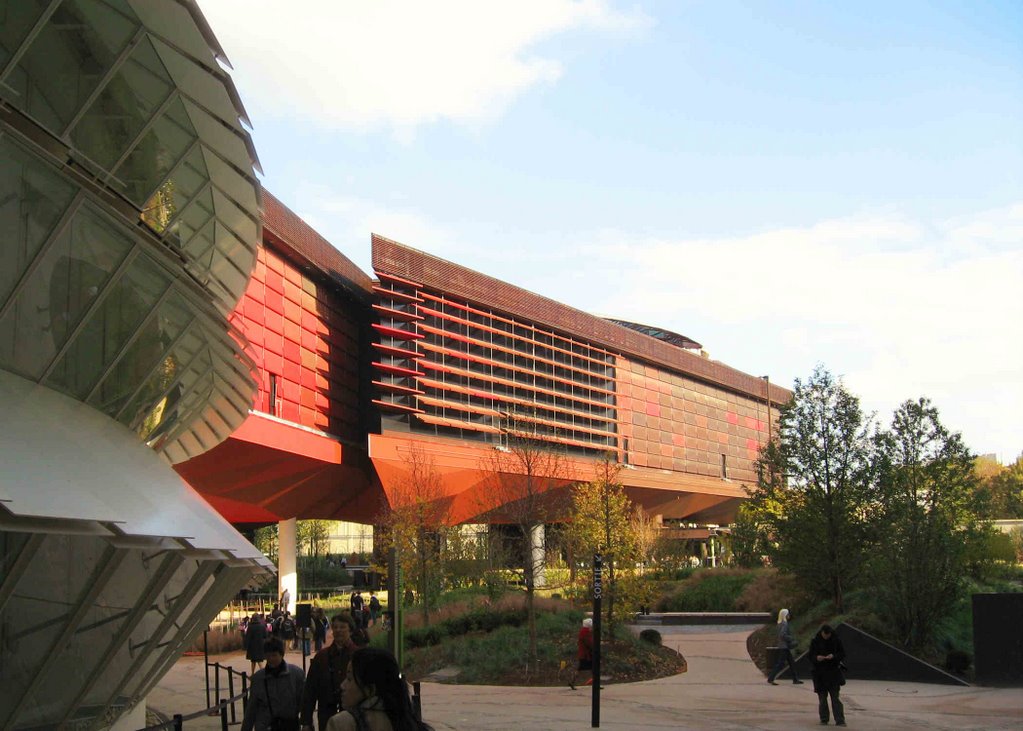

 Protection and promotion of leading collections, in association with temporary exhibits, capitalizing on the museum’s diverse resources, or taken from international collaborations. An informational Internet portal also provides access to all the collections.